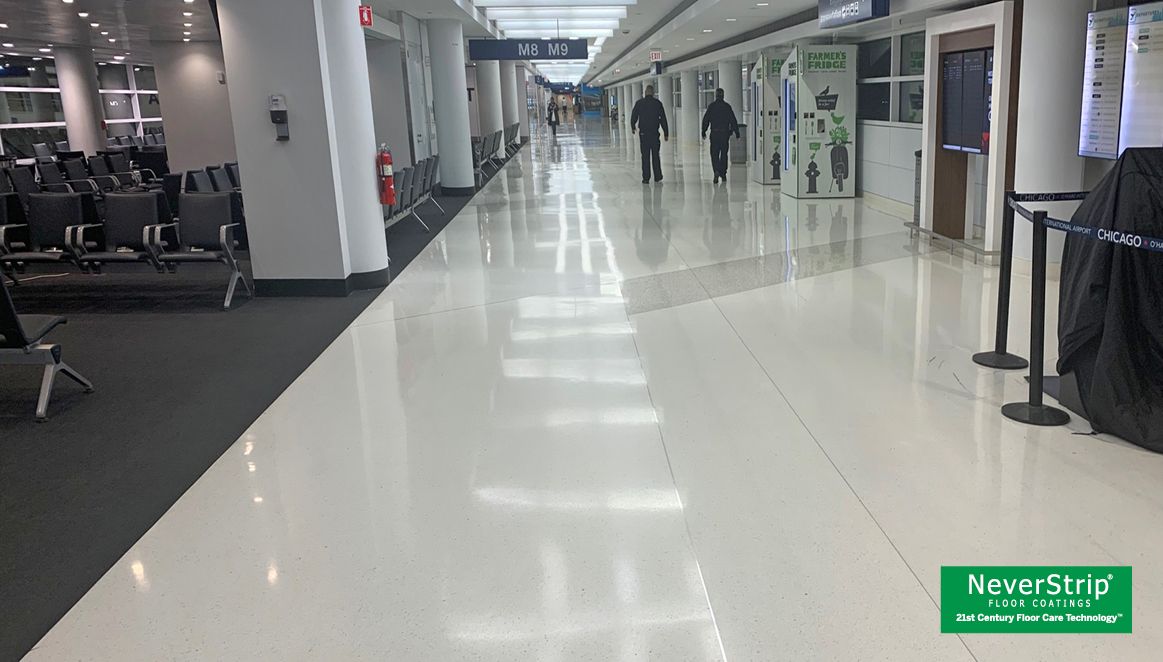
High-traffic airport corridor with resilient flooring maintained using a non-stripping floor protection system.

PFAS-Free Floor Care Products Explained

What Really Matters in Modern Floor Protection

Questions about PFAS are becoming more common in floor care conversations. Sometimes they come from procurement teams. Sometimes from sustainability groups. Sometimes, from leadership simply asking, “Is this something we need to be thinking about?”

For most facilities, the goal is not to chase trends or chemical terminology. The goal is to understand whether PFAS-free floor care products change how floors are protected, maintained, and managed over time.

This blog explains what PFAS-free means in the context of floor care, why it matters operationally, and how modern, non-stripping floor protection systems fit into the discussion.

What Are PFAS, in Practical Terms?

PFAS (per- and polyfluoroalkyl substances) are a broad group of synthetic chemicals that have historically been used across many industries because of their ability to repel water, oil, and soil, as outlined by the U.S. Environmental Protection Agency in its overview of PFAS.

In traditional floor care products, PFAS have most often been used to:

  • Improve stain and soil resistance

  • Enhance slip resistance performance

  • Extend wear characteristics in conventional floor finish systems

The concern surrounding PFAS is not short-term performance. It is long-term persistence. These compounds do not readily break down in the environment, which is why they are often described as “forever chemicals.”

As awareness has grown, more organizations are asking whether PFAS are necessary in floor care systems at all.

Why PFAS-Free Matters in Floor Care

In floor care, PFAS-free is less about chemistry debates and more about risk reduction, simplicity, and future-proofing.

Facilities typically explore PFAS-free products for several practical reasons:

  • Reduced long-term environmental persistence concerns

  • Alignment with broader sustainability or ESG expectations

  • Fewer questions during procurement and approval processes

  • Less uncertainty as awareness and scrutiny continue to increase

What matters most operationally is this:

PFAS-free does not automatically mean reduced performance.

Modern floor protection performance is increasingly driven by surface structure, density, and maintenance design, not chemical additives layered into thick finishes.

Grocery store aisle with resilient flooring in a high-traffic retail environment

PFAS-Free Does Not Mean “Chemical-Free”

One common misunderstanding is that PFAS-free means a product contains no chemistry.

All effective floor protection relies on chemistry. The difference lies in the components of the chemistry

Modern Micron Sealer systems achieve protection through:

  • Micron-thin application rather than thick build-up

  • Dense, non-yellowing surface structure

  • Surface-level soil control instead of soil being absorbed into soft films

This design reduces the need for additives that were historically used to compensate for thick, sacrificial floor finishes that degraded over time.

In short, protection comes from system design, not chemical intensity.

How Micron Sealers Align with PFAS-Free Design

Micron Sealers were developed around a different premise than traditional strip-and-recoat programs: protect the floor with as little material as necessary, and maintain it without disruptive resets.

Because Micron Sealers:

  • Are micron-thin rather than layered

  • Do not rely on soft film build-up

  • Are maintained through routine cleaning and refreshment in the field processes

They do not depend on PFAS to deliver stain resistance, cleanability, or appearance consistency.

This alignment is not the result of reacting to PFAS awareness. It is the outcome of 21st Century Floor Care thinking, where long-term performance is achieved through smarter protection and simpler maintenance—not stronger chemicals.

PFAS-Free and Non-Stripping Maintenance Go Together

Traditional strip and wax programs often rely on aggressive chemistry to:

  • Remove embedded soil

  • Correct yellowing

  • Reset uneven layers of finish

Over time, this increases chemical use, labor demands, and disruption.

Non-stripping floor finish take a different approach:

  • Protection remains thin and dense

  • Soil stays on the surface instead of becoming embedded

  • Appearance can be renewed through refresh steps rather than stripping

PFAS-free products align naturally with this model because they support preventative maintenance, not chemical escalation.

Is PFAS-Free Becoming a Requirement?

In some countries, including parts of Canada and the United States, PFAS scrutiny is increasing across many product categories. Floor care is not always the primary focus, but awareness is clearly growing.

From a practical standpoint, choosing PFAS-free floor care products:

  • Reduces future uncertainty

  • Simplifies internal conversations

  • Aligns with broader environmental and indoor space expectations

For many facilities, this is less about immediate regulation and more about making decisions that will hold up over time.

What PFAS-Free Does Not Automatically Solve

It is important to be clear about boundaries.

PFAS-free status alone does not:

  • Eliminate labor shortages

  • Replace the need for routine cleaning

  • Correct poor maintenance design

  • Guarantee consistent appearance

Those outcomes depend on choosing floor finishes that are compatible with real-world staffing, traffic, and maintenance windows.

PFAS-free is one component of modern floor care—not a standalone solution.

Common Questions That Come Up

Are PFAS-free floor care products less durable?

Not necessarily. Durability today is driven more by surface density and maintenance compatibility than by chemical additives.

Do PFAS-free products cost more?

Product pricing varies, but lifecycle costs are often lower when PFAS-free products are part of a non-stripping, refreshable system.

Does PFAS-free matter in all facilities?

It tends to matter most where sustainability expectations, public visibility, or stakeholder scrutiny are higher. Many facilities also choose PFAS-free simply to reduce complexity and future questions.

The Simple Way to Think About It

PFAS-free floor care products are not about chasing trends or responding to headlines.

They reflect a broader shift toward:

  • Smarter surface protection

  • Fewer chemicals over the floor’s lifecycle

  • Maintenance systems designed for real-world constraints

Micron Sealers support this shift by design, helping facilities protect floors, reduce disruption, and maintain a consistent appearance, without relying on stripping cycles or unnecessary chemical escalation.

Want to Understand How This Applies to Your Floors?

PFAS-free is only one part of a modern floor care program. The real value comes from matching the system to your floor type, traffic level, and maintenance realities.

Contact NeverStrip to learn more about Micron Sealers and how PFAS-free, non-stripping protection fits into a practical, long-term floor care strategy.