
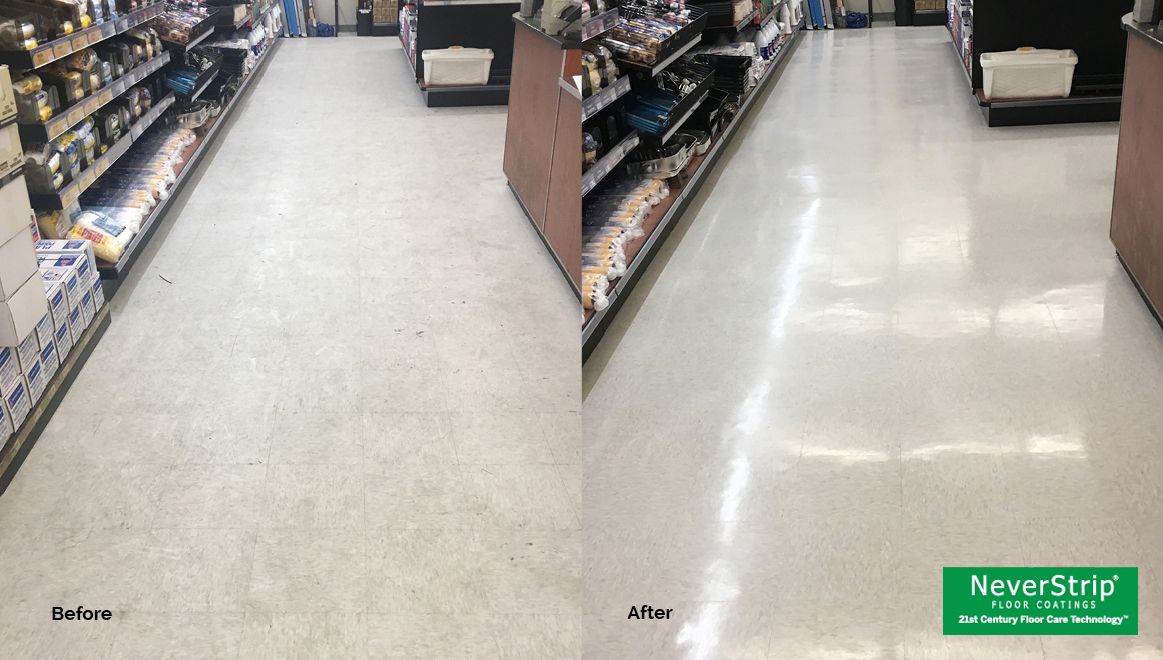
Refreshable LVT floor protection in a commercial grocery store

Why Refreshable LVT Floor Protection Matters More Than Factory-Applied UV-Cured Urethane Durability Alone

Luxury vinyl tile has become one of the most widely installed commercial flooring categories in the world. Each year, hundreds of millions to billions of square feet of LVT and similar resilient flooring products are manufactured and installed across healthcare, education, retail, corporate, and public environments.

Nearly all of this flooring enters the market with a factory-applied, UV-cured urethane coating. These coatings are designed to provide durability, abrasion resistance, and initial protection during early use.

From a manufacturing standpoint, this approach makes sense. From a long-term facility maintenance standpoint, experience in the field has shown that durability alone does not resolve how LVT floors actually age, wear, and look over time.

The issue is not that factory-applied urethane fails. The issue is that once appearance declines, there is no practical, repeatable way to refresh or restore that urethane in the field.

This gap has become one of the most significant and least addressed challenges in modern LVT floor care.
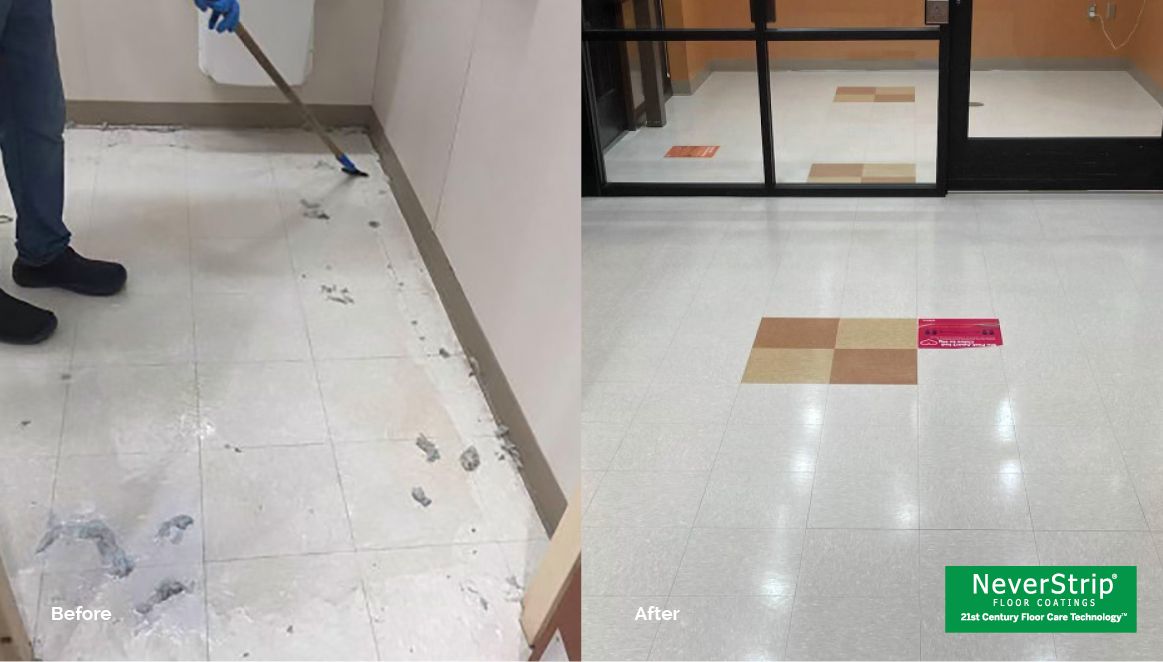
The Role of Factory-Applied UV-Cured Urethane in LVT

LVT manufacturers apply UV-cured urethane coatings at the factory to provide a consistent, durable wear layer. These coatings are often enhanced with additives intended to improve abrasion resistance and reduce visible wear during early use.

The promise is straightforward. The floor should resist traffic. Routine cleaning should be sufficient. Additional floor finishes or coatings should not be necessary.

In low-demand environments, this may hold true for a period of time. In demanding commercial spaces, however, a different reality emerges.

What Actually Happens to LVT Floors in Real Facilities

In active facilities, LVT floors are exposed to continuous foot traffic, rolling loads, carts, particulate soil, and repeated cleaning cycles. Over time, the factory-applied urethane develops micro-scratches across the surface.

These micro-scratches are often not immediately visible. The problem becomes apparent when soil begins to collect and deposit within those microscopic abrasion points.

As this occurs, several things happen at once.

The floor becomes harder to clean. Routine cleaning no longer restores a uniform appearance. The surface begins to look dull, uneven, and worn, even though the urethane coating is still present.

This is the moment where many facilities realize that durability alone does not equal maintainability.

The Core Problem Is Not Durability. It Is Recoverability.

Factory-applied UV-cured urethane is durable. It does not simply wear off under normal conditions. That is not the failure mode facilities experience.

The real issue is that factory-applied urethane is not designed to be refreshed or restored in the field.

Once micro-scratching and soil entrapment reach a certain point, facilities are left with limited options.

They can accept the degraded appearance. They can increase cleaning intensity, which often accelerates wear. Or they can replace the floor entirely.

Reapplying UV-cured urethane in the field is rarely practical. The process requires specialized equipment, controlled conditions, extended downtime, and highly skilled labor. In most commercial environments, this is not a realistic maintenance path.

As a result, the industry has a growing problem. Floors that are structurally sound and still under warranty become visually unacceptable, with no practical recovery solution built into the original protection model.

Why a Refreshable Approach Changes the Equation

Refreshable floor protection addresses the part of the lifecycle that factory-applied urethane does not.

Rather than relying on a single, non-renewable wear layer, refreshable protection introduces a maintainable surface that can be renewed incrementally in the field.

The focus shifts from resisting wear at all costs to managing wear in a predictable, repeatable way.

In a refreshable model, soil remains on the surface rather than becoming embedded. Micro-scratches are addressed as part of normal maintenance rather than allowed to accumulate. Appearance is maintained continuously instead of declining between major interventions.

This approach aligns with how facilities actually operate.

Protecting LVT Early Before Appearance Declines

The most effective time to address the limitations of factory-applied urethane is before visible problems appear.

NeverStrip Shield™ is designed to protect intact factory-applied urethane by improving cleanability and reducing the impact of abrasion and soil deposition. Applied early, it acts as a sacrificial, refreshable protection layer that absorbs day-to-day wear that would otherwise degrade the original urethane surface.

By protecting the factory-applied urethane from the start, facilities can slow the development of micro-scratching, maintain a more uniform appearance, and significantly extend the useful visual life of the floor.

This proactive approach preserves the original investment and delays the need for more intensive intervention.

Restoring Appearance When Wear Has Already Occurred

In many facilities, LVT floors are already showing signs of appearance degradation by the time refreshability is considered.

In these cases, Micron Sealers™ such as Vinyl Seal can be used to restore appearance by addressing surface wear and improving uniformity without stripping or removing the factory-applied urethane.

Once appearance is restored, NeverStrip Shield™ can then be applied to preserve the renewed surface and support ongoing refreshability.

This combination allows facilities to move from a declining appearance trajectory to a manageable, long-term maintenance model.

NeverStrip designs Micron Sealers™ and NeverStrip Shield™ to work together in this way, allowing protection strategies to be tailored to the current condition of the floor rather than forcing a one-size-fits-all approach.

The Operational Benefits of In-Field Refreshability

A refreshable LVT floor protection model delivers operational benefits that durability alone cannot provide.

Maintenance can be performed within normal maintenance windows. Dry-down times are short, allowing floors to return to service quickly. Specialized equipment is not required, and work can be performed by in-house or contracted floor care teams using standard tools and pads.

Because the process focuses on refreshing rather than removal, chemical use is reduced over time. Labor requirements are lower. Disruption to occupants is minimized.

Most importantly, appearance remains consistent. Floors are maintained as they wear, not ignored until they become a problem.

LVT floor wear and appearance decline in an active facility

Why Refreshability Aligns With Modern Sustainability Expectations

Sustainability in floor care is increasingly measured across the full lifecycle of the floor, not just by product ingredients.

Refreshable floor protection supports sustainability by reducing the frequency of aggressive restoration, lowering chemical and water use, minimizing waste, and extending the service life of installed flooring.

By preserving floors that would otherwise be replaced prematurely due to appearance issues, facilities reduce material consumption and the environmental impact associated with replacement.

This alignment with lifecycle thinking is becoming increasingly important across commercial, institutional, and public environments.

A Practical Way to View the LVT Floor Care Challenge

Factory-applied UV-cured urethane provides durability. What it does not provide is a long-term, in-field recovery path once appearance declines.

Refreshable floor protection fills that gap.

By protecting early, restoring when needed, and maintaining continuously, facilities gain control over appearance, cost, and disruption in a way that durability alone cannot deliver.

This is not a rejection of factory-applied urethane. It is an acknowledgment of its limits in real-world environments and a practical response to those limits.

Frequently Asked Questions

Is factory-applied UV-cured urethane ineffective?

No. It is effective at providing initial durability. The challenge is that it cannot be refreshed once micro-scratching and soil entrapment occur.

Does refreshable protection replace routine cleaning?

No. Routine cleaning remains essential. Refreshable protection improves cleanability and makes routine cleaning more effective.

Is refreshable LVT protection only for high-traffic areas?

High-traffic areas benefit the most, but any environment where appearance consistency and long-term cost control matter can benefit.

The widespread use of LVT with factory-applied UV-cured urethane has created a new reality in commercial floor care. Floors last longer structurally, but they become harder to maintain visually.

Refreshable floor protection addresses this reality directly.

By adding a practical, in-field recovery path to the LVT lifecycle, facilities can preserve appearance, extend floor life, reduce disruption, and lower the total cost of ownership.

That is why refreshability matters more than durability alone in modern LVT floor care.

Want to Explore How This Applies to Your Floors

Every facility is different, and the right approach depends on floor condition, traffic levels, and maintenance resources.

Contact NeverStrip to learn more about NeverStrip Shield™ and Micron Sealer™ applications and how refreshable LVT floor protection can be integrated into a realistic, long-term maintenance plan.