
In schools, healthcare facilities and long-term care communities, restrooms are often cleaned several times a day and still look stained or smell stale by the afternoon. The problem usually isn't the cleaning. It's the grout, the aging surfaces and a maintenance routine that was never built to fix them. This five-step approach shows how to restore, protect and control odor so the results actually last.
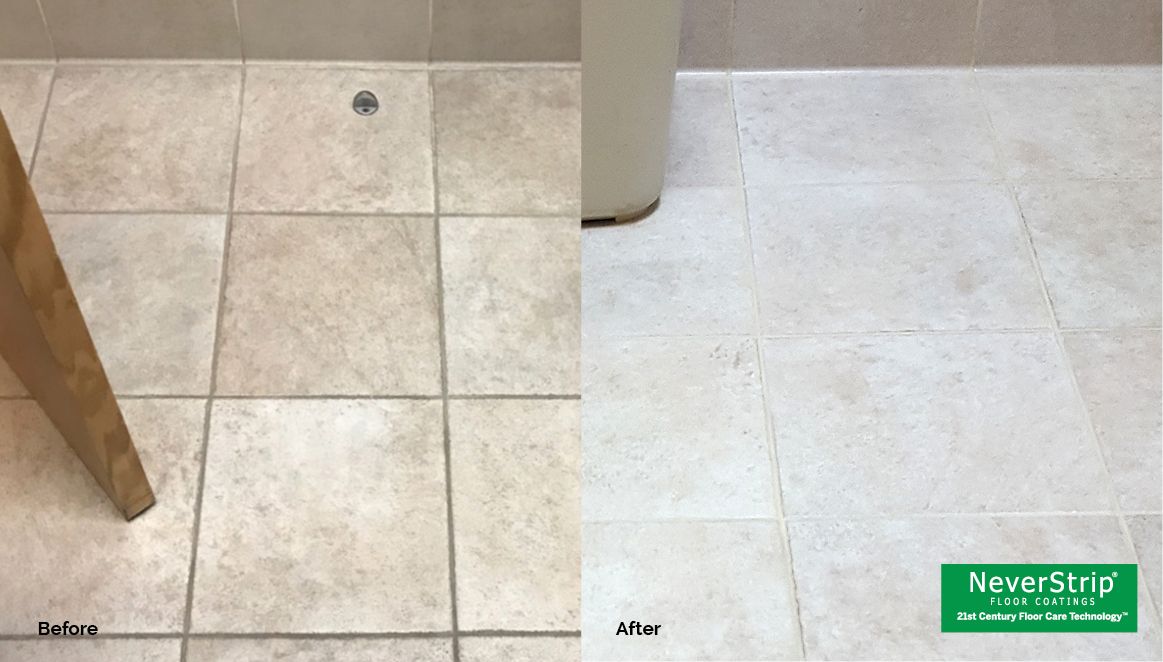
Beyond Clean: A Better, 21st Century Approach to Restroom Maintenance and Odor Control
In schools, healthcare facilities, long-term care communities and other high-use environments, restrooms, locker rooms and similar spaces can be among the most challenging to maintain.
They may be cleaned multiple times a day, yet urine-stained flooring and grout, aging surfaces and persistent odors can leave a restroom looking or smelling as though it hasn't been properly maintained.
The answer isn't always more cleaning or better cleaning.
Sometimes, the problem is the condition of the surfaces themselves and the maintenance cycle that has developed around them.
That's where a more complete and holistic approach using 21st Century floor care and cleaning technologies can make a fundamental difference.
Beyond Cleaning: Treating the Restroom or Locker Room as a System
Daily cleaning will always be essential. But cleaning alone often can't restore discolored flooring or grout, remove years of accumulated, degraded floor finish, protect a newly restored surface or deliver ongoing odor control.
Instead of treating each of these as separate problems, NeverStrip addresses the entire surface-care process, providing a superior appearance with easier, more cost-effective maintenance.
Prepare. Clean. Restore. Protect. Control Odor.
Each step has a different purpose, but together they can create an environment that looks better, is easier to maintain and addresses odor beyond the daily cleaning cycle.
1. Prepare the Existing Surface
Before deciding how to restore a floor, it's important to understand what's already on it.
In some facilities, years of maintenance may have left layers of conventional floor finish or wax that need to be removed before the underlying tile and grout can be properly addressed.
Where existing finish needs to be removed, MicroBot Floor Finish Eliminator provides an environmentally superior alternative to traditional chemical stripping.
NeverStrip MicroBot Floor Finish Eliminator is a microbial-based product containing trillions of a naturally occurring, targeted mix of microorganisms that quickly convert floor finish/wax into water and carbon dioxide, with less labor and in less time than conventional high-pH floor finish strippers. This product and technology can eliminate the need for harsh chemical strippers while helping reduce the labor, odors and cleanup associated with conventional stripping.
Not every floor will require this step. The goal is to prepare the existing surface appropriately based on its condition.
2. Clean the Tile and Grout
Once the surface has been properly prepared, the tile and grout can be thoroughly cleaned, first with a high-pH product formulated to eliminate organics in the grout, followed by a low-pH solution to attack minerals.
The combination of the two cleaners provides a one-two punch toward achieving really clean grout.
This is an important distinction.
Cleaning isn't being eliminated from the maintenance process. It's being put into a larger strategy.
Removing accumulated soils and contaminants gives the facility a clean foundation for the restoration and protection steps that follow.
And once that work has been completed, routine cleaning remains an essential part of maintaining the space.
3. Restore Rather Than Automatically Replace
Even after a thorough cleaning, older grout can remain stained or discolored and prone to degradation, eventually returning to a "bad" state.
That can make an otherwise serviceable tile floor appear dirty or worn, regardless of how often it is cleaned.
The NeverStrip Grout Color Restoration System is a proven, refined solution that has been used in thousands of restrooms across North America since 2013.
Rather than removing an existing tile floor simply because its appearance has deteriorated, the grout and the ceramic or porcelain tile itself can be refreshed and restored, often to a better-than-new appearance. This can provide a cleaner, more consistent appearance while extending the useful life of the existing surface, whether wall or floor.
For facilities with any significant amount of square footage, the ability to restore rather than replace deserves consideration for many reasons, including cost, convenience, labor constraints and facility operations.
4. Protect the Restored Surface
Once the tile and grout have been cleaned and restored, the next questions become:
How do we protect what we've just accomplished?
How do we make the surface easier to maintain?
How do we improve the performance of the space, including reducing odors inherent in restroom facilities?
Applying the appropriate NeverStrip Micron Sealer protects the restored surface, supports easier ongoing maintenance and provides additional performance benefits, such as reduced odors.
Instead of repeatedly trying to correct the same appearance problems, the objective is to create a surface-care system designed with long-term maintenance in mind.
5. Take Odor Control Beyond the Floor
A restroom isn't just a floor.
It's a collection of surfaces: floors, walls, partitions, toilets, urinals, mirrors and other areas that are continually exposed to the restroom environment.
That's particularly important when considering odor.
Traditional cleaning addresses soils and contaminants during the cleaning cycle. But in heavily used facilities, odor can become noticeable again between cleanings.
NeverStrip Micron Shield adds another component to the surface-care strategy by providing ongoing odor elimination on treated surfaces without the need for UV light.
NeverStrip Shield can be applied to surfaces throughout the restroom, including ceramic, porcelain, grout, glass and stainless steel, allowing facilities to think about odor control across the entire environment rather than addressing the floor alone.
Shield is also simple to apply, dries in approximately two minutes, has no odor and is designed to perform for years.
NeverStrip Shield's technology also differs from titanium-dioxide-based systems that rely on UV light for activation. NeverStrip Shield functions in the presence of oxygen and does not require UV light to perform its odor-elimination function.
That makes odor control part of the ongoing surface strategy rather than simply a response when an odor becomes noticeable.
Cleaning Still Matters — It Just Doesn't Have to Do Everything
For maintenance teams, the objective isn't to eliminate routine cleaning.
It's to stop asking routine cleaning to solve problems it wasn't designed to solve.
A mop can't restore permanently discolored grout.
Daily cleaning can't protect a surface that hasn't been properly sealed.
And repeatedly cleaning a restroom isn't necessarily the same thing as creating an ongoing odor-control strategy.
By looking at the entire environment, facilities can address each of those challenges individually while creating a system that works together.
Prepare. Clean. Restore. Protect. Control Odor.
For schools, healthcare facilities, long-term care communities and other high-use environments, this approach offers a different way to think about restroom maintenance.
Ready for restrooms that stay clean between cleanings?
Every facility is different. Tell us about your restrooms and we'll help you figure out which steps make sense for your surfaces, your team and your budget.