
Product price is only the start. Learn how labor, downtime and stripping cycles shape the true lifecycle cost of maintaining a commercial hard-surface floor.
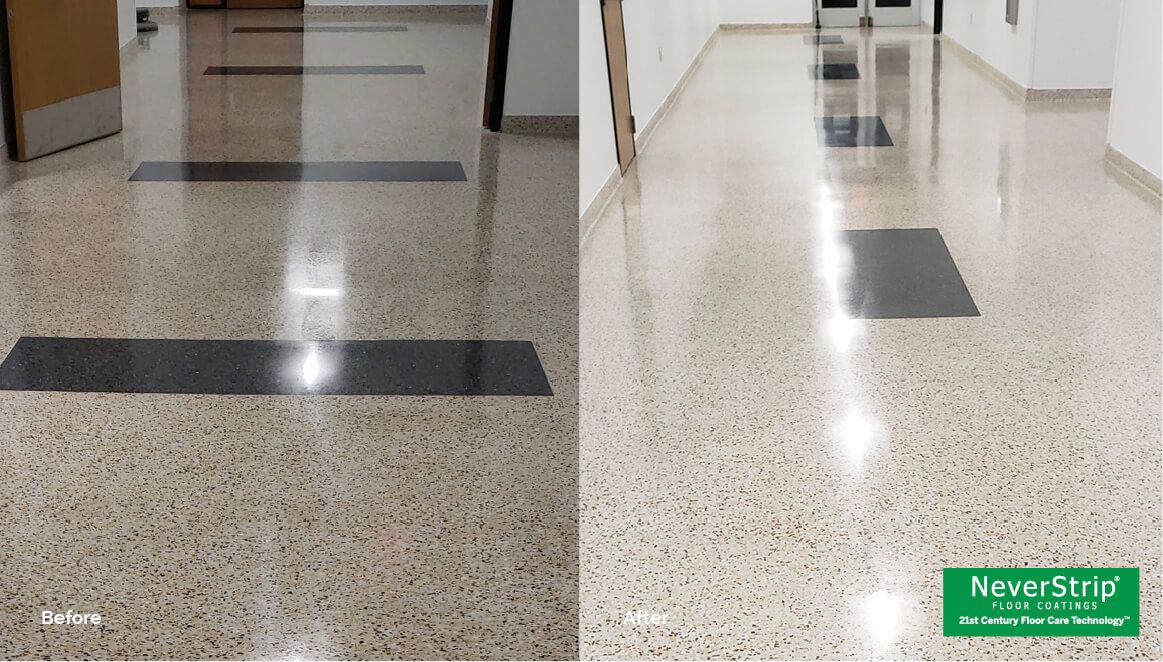
What Does a Hard-Surface Commercial Floor Really Cost to Maintain?
The cost of a commercial floor is usually easiest to see at the beginning.
There is the flooring itself. Installation. Maybe a coating or protective treatment. Those numbers show up clearly in project budgets and bids.
What is harder to see is what happens next.
For years after the floor is installed, someone has to clean it, maintain its appearance, respond when high-traffic areas begin to show wear, and periodically perform whatever restorative work the floor-care program requires.
That is where the economics of commercial flooring can change considerably.
For a facility manager comparing floor-care options, the more useful question may not be, "What does this product cost?"
It may be:
"What will this floor, in this space, with its demands, require us to do over the next five or ten years?"
Labor changes the calculation
Labor is the biggest reason initial product prices can be misleading.
Cleaning & Maintenance Management's 2026 In-House/Facility Management Survey found that labor challenges remain the top concern among facility managers and supervisors overseeing in-house custodial teams, with budget limitations close behind. The survey points to ongoing difficulty attracting and retaining staff at the same time facilities are managing the cost of supplies, equipment, training and new technology. (Cleaning & Maintenance Management)
ISSA makes a similar point when discussing commercial cleaning costs: labor pricing has to account for wages, benefits, payroll costs, training and other indirect expenses, and improving productivity can have a significant effect on overall cost. (ISSA)
Floor care is part of that labor equation.
Consider the difference between purchasing a gallon of floor finish and maintaining the floor-care program that goes with it. The product has a visible price. The labor required to prepare the floor, apply the finish, maintain it, restore it and eventually repeat major procedures is spread across months and years.
Those hours have a cost. In fact, floor-care labor often becomes the largest component of the cost of the flooring.
And when custodial teams are already stretched, there is another question worth asking: What else could that team be doing with the time currently devoted to labor-intensive floor maintenance?
Downtime Should Be Part of the Conversation too
Not every floor-care cost appears in the maintenance department's product budget.
Some show up as disruption.
A school may have to fit major floor work into a summer or holiday maintenance window. A healthcare facility has to work around occupied spaces and continuous operations. Retail, airports, offices and other busy commercial environments have their own tight scheduling challenges.
Drying and application time matter because someone has to plan around them.
An area that cannot return to service is not simply "drying." It can affect operations, customer satisfaction, costs and profits. The facility may have to reroute traffic, move furniture, schedule work after hours at higher labor rates or coordinate maintenance around building occupants.
That operational effect is difficult, maybe impossible, to capture by comparing the purchase price of two floor-care products.
It can be very real nonetheless.
This is one reason NeverStrip's Micron and Shield Sealer systems are designed around a different maintenance model. Micron and Shield Sealers dry in approximately 10 and 2 minutes, respectively, between applications and, in a normal lifecycle, do not require the traditional, wasteful, costly and disruptive stripping process associated with conventional floor finish programs.
Those dry times are product specifications.
For the person running the facility, however, their importance is often fundamental to operations. A shorter application window can make floor work easier to schedule around everything else that needs to happen in the building.
Repetition is where lifecycle costs build
A floor-care procedure that happens once may not look particularly expensive.
A procedure that repeats every year, or more frequently, is a different story, and those repeats can carry significant operational costs.
Traditional floor finish programs can involve routine cleaning, burnishing, scrub-and-recoat procedures and, at some point, stripping and recoating. The exact schedule varies considerably based on floor type, traffic, appearance expectations and maintenance practices.
That variability is why a credible lifecycle comparison should use the actual maintenance program for a facility rather than a generic industry number.
Still, the basic math is straightforward.
If a procedure requires labor, materials and downtime, and the procedure happens repeatedly, its cost compounds over the life of the floor.
The same is true in the other direction. If a floor-care system eliminates or reduces a recurring major procedure, the economic value is not limited to the product that is no longer purchased. The labor and scheduling associated with that procedure matter as well.
This scenario is most common with the #1 hard-surface resilient flooring dominating the marketplace: luxury vinyl tile (LVT). When the UV-cured urethane applied to LVT in the factory is compromised by scratches and other imperfections, what is a facility to do? Who would apply floor finish? No one in their right mind. A facility cannot cost-effectively or operationally remove the imperfections (due to many factors, including the non-homogeneous nature of LVT) and apply a similar UV-cured urethane. What does the lack of a refreshable surface add to the lifecycle cost of LVT ownership?
This is where facilities can miss a significant part of the comparison when they focus primarily on initial cost per gallon or cost per square foot.
What happens when the floor starts to wear?
There is another lifecycle question that deserves more attention.
What is the recovery path?
Commercial floors are used. They are walked on, rolled over, cleaned and exposed to soil day after day. Eventually, appearance changes.
At that point, what does the floor-care system require?
Does the existing protection have to be removed?
Is a major restorative process required? Is a restorative process possible?
Can only the affected high-traffic areas be addressed?
Can the protective surface be refreshed in the field?
Or does the facility simply live with declining appearance until a larger intervention (like ripping out the floor and replacing it) becomes unavoidable?
This is why cost-effective field refreshability sits at the heart of NeverStrip's value proposition.
Rather than treating wear as the point where the maintenance process has to start over, Micron Sealer and Shield systems can be refreshed as part of a scheduled, routine floor-care process that is cost-effective and sustainable. The objective is to maintain the protective surface over its lifecycle without stripping becoming part of the maintenance cycle.
That distinction has consequences for labor, materials, disruption and lifecycle costs.
It also changes how durability should be evaluated.
A floor finish that lasts a long time is useful. But durability alone does not answer what may be the more practical facility-management question:
When the floor eventually needs attention, what will it take to bring it back?
A better way to compare hard-surface floor-care costs
A meaningful comparison should start with the actual floor and the actual facility.
A high-traffic airport concourse does not have the same maintenance demands as a private office. A school hallway and a healthcare corridor may use similar flooring but operate under very different schedules. Texture, soil load, rolling traffic, cleaning equipment and appearance expectations all affect maintenance.
So instead of beginning with two product prices, start by mapping the work.
What does each system require during initial application?
Then follow it through routine maintenance. Look at the cleaners, pads and equipment required and, most importantly, the labor hours.
Next, identify the periodic work. Does the floor need burnishing? Scrub-and-recoat procedures? How frequently? What happens in the highest-traffic areas?
Then look at major restoration. If stripping is part of the program, how often does it realistically happen in that facility? How much labor and preparation does it require? How long is the space affected?
Finally, look at recovery. When the floor begins to show wear, such as scratches, can it be economically refreshed, or does restoration require starting over, such as installing a replacement floor?
Put those costs across five or ten years and the comparison becomes much more meaningful.
The lowest initial price and the lowest lifecycle cost are not always, or even typically, the same thing
NeverStrip Micron and Shield Sealers represent a different approach from conventional floor finish or the industry's LVT floor-care model, which relies on a factory-applied UV-cured urethane.
NeverStrip Micron and Shield Sealers bond directly to virtually any hard surface (including glass), dry in 2 to 10 minutes between coats, are cost-effectively refreshable on a continuous basis and are designed around no stripping during their normal lifecycle. NeverStrip's Micron and Shield Sealer technologies are used on hard-surface commercial flooring ranging from LVT, VCT and sheet vinyl to linoleum, rubber, stone, terrazzo, concrete, ceramic and porcelain.
That does not mean every NeverStrip application will produce the same savings.
Floor condition matters. Traffic matters. The existing maintenance program matters. Labor rates matter. And the right comparison should be based on the facility's real numbers rather than a broad percentage pulled from another building.
But it does mean facility managers have another way to evaluate their options.
Instead of asking only:
What will it cost us to coat this floor?
Ask:
How much labor will we put into maintaining it?
How often will major restorative work be required?
How much of that work has to happen when the building would otherwise be in use?
What happens when the floor begins to show wear?
What will this entire program cost us over the life of the floor?
How can we best ensure our resilient floor, especially luxury vinyl flooring, can be a 30-year floor?
Those questions get much closer to the true economics of commercial floor care.
Because the cost of a floor-care system is not simply what goes onto the floor.
It is everything the facility has to keep doing after it gets there.
Every facility’s floors, traffic and maintenance program are different. Talk with our team about what your floor-care program costs today and what it could look like without stripping in its normal lifecycle.
Contact Us to Learn More