
A worn commercial resilient floor doesn’t always need to be replaced. Learn what to evaluate before making that decision, when restoration may be an option, and why refreshability matters for long-term floor performance.
Does a Worn Commercial Resilient Floor Really Need to Be Replaced?
What typical commercial foot and cart traffic means for worn resilient flooring and when replacement may not be the only option.
A commercial floor at a school, retail store, health care facility, etc., can reach a point where it simply looks worn out.
Traffic patterns become obvious. The surface loses its original appearance. Scratches accumulate. Routine cleaning still removes soil, but it no longer brings the floor back to the condition the facility expects or was before.
Eventually, replacement starts to look like the next logical step.
Sometimes it is. Flooring can be damaged, improperly installed or simply reach the end of its useful life.
But a floor that looks like it needs to be replaced doesn't always need to be replaced.
Before committing to removing and replacing thousands of square feet of flooring, it is worth finding out what has actually failed.
Is the flooring itself at the end of its useful life, or is the problem primarily at the surface?
Those are not necessarily the same thing.
Start With the Condition of the Existing Floor
There isn't one answer for every worn commercial floor.
LVT, VCT, sheet vinyl, linoleum, rubber and other resilient flooring all have different characteristics. The condition of the flooring, previous maintenance products, factory-applied treatments, traffic and the type of wear all matter.
A protective treatment also can't correct every underlying flooring problem. If the floor or substrate has failed, restoration may not be appropriate.
But when the flooring itself remains serviceable, addressing the surface may be an option worth considering before removing the floor.
NeverStrip has taken this approach in a variety of commercial environments. The NeverStrip case study library includes LVT restoration in a South Dakota school, renovated LVT at the Onondaga County War Memorial, vinyl plank restoration in a Texas office and other resilient-floor applications.
The point isn't to make a failed floor look better temporarily. It is to determine whether an existing floor is still a good candidate for restoration, protection and continued long-term use.
Restoring the Floor’s Appearance Is Only Part of the Decision
Getting an existing floor back into good condition addresses an immediate problem.
The next question is what happens as the floor goes back into service.
Commercial resilient flooring takes abuse. People walk across it. Carts and equipment roll over it. Dirt and grit are tracked in. It is cleaned over and over again. Improper furniture glides abuse the floors. High-traffic areas eventually show that use.
So when evaluating a floor protection system, durability is only part of the conversation.
What happens when the protected surface begins to show wear?
This is where refreshability matters. Resilient flooring coming out of the factory is generally, inherently NOT refreshable.
NeverStrip Micron Sealers are micron-thin floor protection systems that bond directly to the floor surface. They are used on all resilient, commercial surfaces including LVT, VCT, sheet vinyl, linoleum, rubber and bio-based tile, as well as non-resilient surfaces such as stone, terrazzo, concrete, ceramic, porcelain and brick.
Micron Sealers, unlike resilient flooring from the factory, are also cost-effectively refreshable in the field and are designed for no stripping in a normal lifecycle.
Instead of considering only at how long a protective surface can resist wear, a facility can/should also consider with equal or even greater vigor, how that surface will be maintained/refreshed/restored when wear eventually occurs or better yet, how does the facility continuously refresh and maintain their floors on an ongoing basis to keep floor looking like new.
Can the protection be refreshed?
What is involved in bringing high-traffic areas back?
Does the maintenance process require removing the existing protection and starting over?
Those questions become increasingly important the longer the floor remains in service.
For LVT specifically, NeverStrip takes a deeper look at this issue in Why Refreshable LVT Floor Protection Matters More Than Durability Alone.
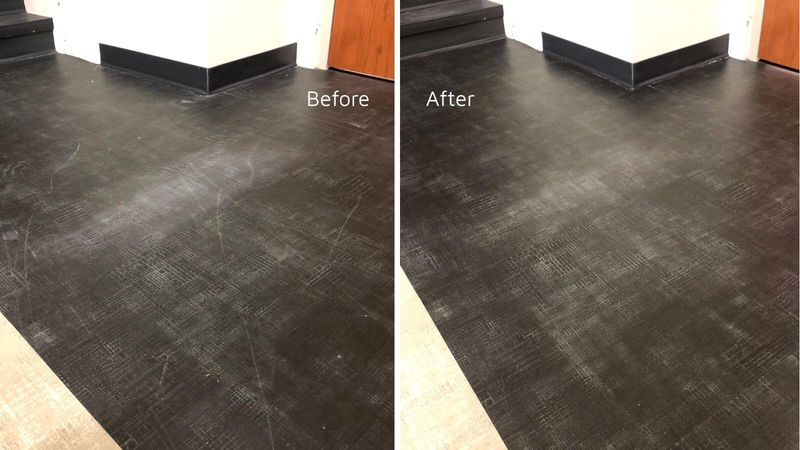
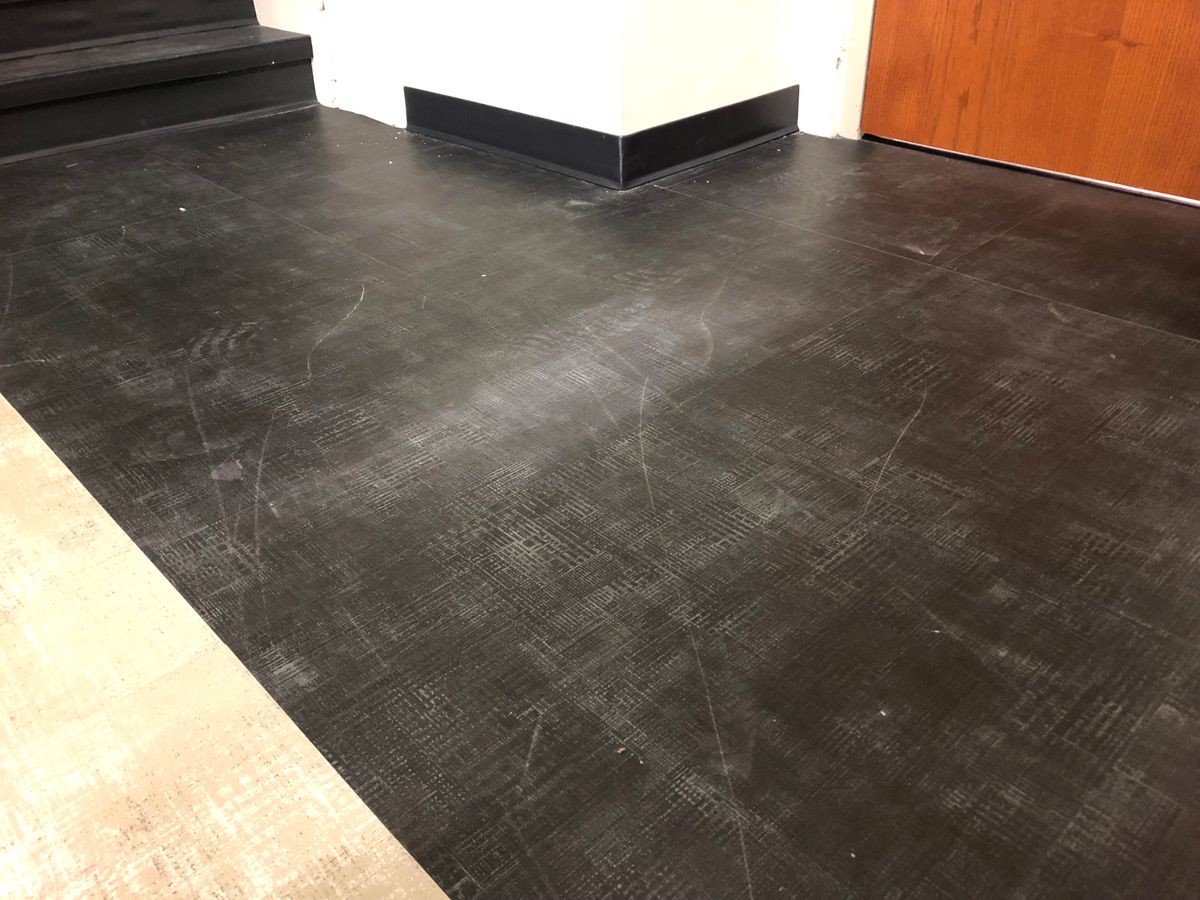
LVT restoration at a South Dakota K–12 school. Before treatment, the black tile showed visible scratches and scuffs. After full treatment, the surface had a significantly improved appearance.
Replacement Has Costs Beyond the New Flooring
There is another reason to evaluate the existing floor before deciding to replace it.
Replacement affects more than the flooring budget.
Furniture and equipment may need to be moved. Existing flooring may need to be removed and disposed of. New flooring has to be installed. The work has to be scheduled, and areas of the building may be unavailable while it takes place.
That can be especially important in schools, healthcare facilities, retail environments, airports and other buildings where shutting down an area isn't simple.
Restoration has its own costs and requirements, of course. The existing floor may need preparation, labor and materials before it can be protected and returned to service.
The right comparison is the one that looks at both options realistically.
What will it take to restore the existing floor?
What will it take to replace it?
How much disruption is involved?
And after either project is complete, what will the floor require to maintain it over the years that follow?
That last question is easy to overlook.
In-Use Time Matters When the Building Is Still in Use
Application time can have a significant effect on how floor work fits into an operating facility.
NeverStrip Micron Sealers dry in approximately 10 minutes between applications.
That specification matters for reasons that have little to do with a product data sheet. Floor work has to happen somewhere, and that space often needs to get back into service.
A shorter application window can make it easier to schedule work around occupants, traffic and other facility operations.
Combine that with a protective system that is cost-effectively and time-effectively refreshable and designed for no stripping in a normal lifecycle, and the maintenance conversation begins to look different.
The question isn't simply how much it costs to treat the floor today.
It is what the floor will ask of the maintenance team over time.
When Replacement Really Is the Right Choice
Not every commercial floor should be restored.
There will be situations where the flooring or underlying substrate has deteriorated beyond what a surface restoration can address. There may be installation problems, physical damage or other conditions that make replacement the appropriate choice.
That's why evaluating the existing floor matters.
Restoration isn't about finding a way to avoid replacement at all costs.
It's about making sure replacement is solving the right problem.
If the flooring itself has failed, replace it.
If the flooring remains serviceable but its surface has become worn and difficult to maintain, there may be another option worth evaluating.
Before You Replace, Find Out What Has Actually Failed
A worn floor and a failed floor are not always the same thing.
For an appropriate existing commercial floor, restoration and protection may provide another path before replacement. And once that floor is protected, the ability to refresh the protective surface can influence what happens years later when traffic and wear begin to show again.
That makes the recovery plan part of the flooring decision from the beginning.
Before replacing a commercial floor because of its appearance, take a closer look at what is actually happening at the surface.
You may have more options than you think.
Schedule a call and find out how NeverStrip and its 21st Century Micron Sealer Products can support your facility.