Before-After_Hospital_Tile.jpg

How to Reduce Hard Surface Floor Care Labor Without Sacrificing Appearance

Facility teams are under pressure to reduce floor care labor without allowing appearance standards to slip. Staffing levels remain tight, square footage per technician continues to increase, and labor costs are absorbing a larger share of operating budgets. At the same time, expectations around clean, consistent floors have not changed.

The challenge is not whether floors will be maintained. The question is how to reduce hard surface floor care labor while maintaining a quality appearance across large portfolios of LVT, VCT, terrazzo, concrete, and other hard surfaces.

The answer increasingly comes down to system design rather than individual tasks.

The Labor Reality in Facility Management

Essentially ALL organizations are operating with fewer floor care technicians than they had five years ago and the floor care workers employed are largely less experienced and oftentimes less motivated. Recruiting and retention remain ongoing issues, especially for work that requires technical skill and off-hours scheduling.

At the same time, each technician is responsible for more square footage. Larger buildings and expanded campuses have not been matched with proportional staffing increases. This places pressure on maintenance programs that depend on labor-intensive restoration events.

Budget conversations reflect this reality. Chemicals are visible line items, but labor drives cost. When facilities evaluate ways to reduce floor care labor, they are often looking first at the largest labor events in their annual cycle.

Where Traditional Hard Surface Floor Care Programs Consume Labor

Daily cleaning is predictable. Periodic stripping is not.

Traditional floor finish systems rely on strip-and-recoat cycles to reset appearance. These processes require chemical application, agitation, slurry removal, rinse steps, dry time, and multiple reapplications. Each stage increases labor exposure and requires controlled conditions.

Dry time compounds the impact. Floors must fully dry before refinishing, and each application introduces additional waiting time. Access restrictions often push projects into nights or weekends, increasing overtime.

High-traffic areas create another challenge. Traditional floor finish systems do not allow for localized repairs, which then expands broader restoration. What begins as corrective maintenance can become a full reset.

For facilities seeking alternatives to the floor finish treadmill of numerous applications of finish; continuously scrub and recoats and required stripping of floor finish, the issue is not cosmetic preference. It is labor volatility; labor availability and labor capabilities.

Micron Sealer Systems as a Labor-Reduction Strategy

Among a number of floor care benefits, the NeverStrip Micron Sealer system was developed to support non-stripping floor care system and protection across essentially all non-carpet flooring types, including LVT, VCT, sheet vinyl, rubber, stone, terrazzo, concrete, ceramic, porcelain, and brick.

Micron Sealers are micron-thin, inorganic, cost effectively refreshable without stripping, which offer superior stain, scratch and abrasion resistance.

Applications dry in 10 minutes or less between coats under normal conditions. Fewer applications are required compared to conventional floor finish systems. Burnishing for higher shine can be done in 30 minutes after application. Shorter dry intervals allow crews to complete work in tighter windows and return spaces to service more quickly.

Importantly, Micron Sealer systems are designed to operate with no need for stripping in a normal lifecycle. The Micron Sealer is refreshed rather than removed. Oftentimes, refreshing does not require new product applications. Reducing the frequency of new applications; scrub and recoats and eliminating strip-and-recoat cycles removes much of the most labor-intensive events in a facility’s annual maintenance plan when using conventional floor finish systems.

For organizations working to reduce floor care labor, removing full reset cycles from the lifecycle often delivers the most measurable impact.

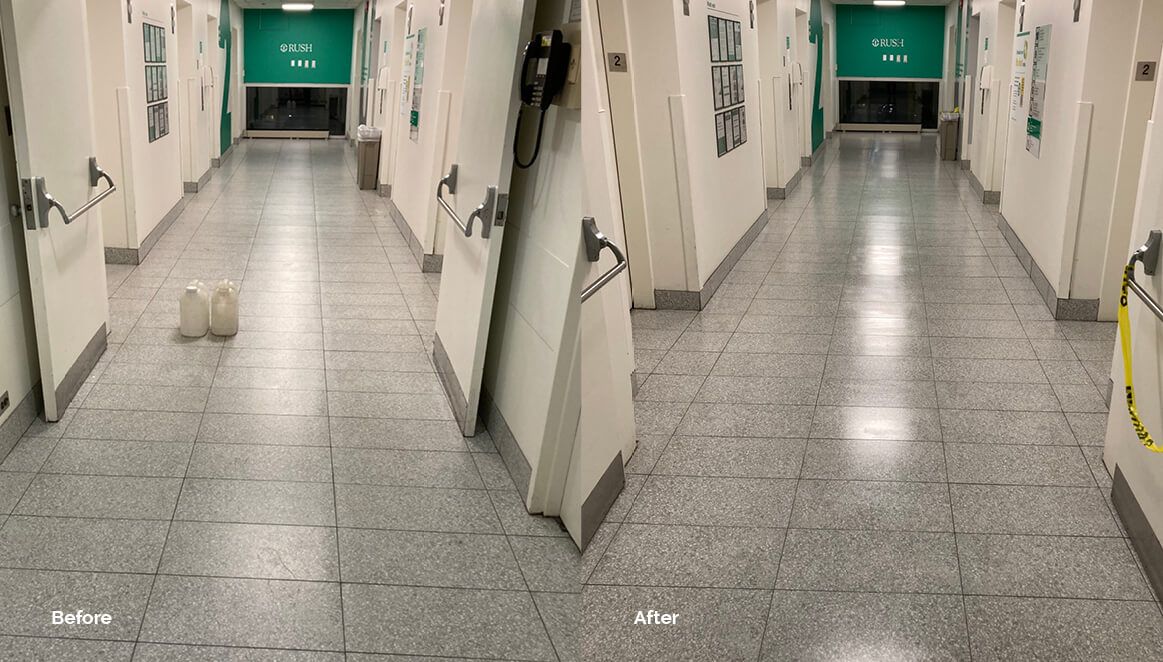
Maintaining or Restoring Appearance Without Full Reset

Reducing labor should not mean lowering standards. It requires a system that supports a consistent appearance without repeated removal.

Because Micron Sealer applications are refreshable, high-traffic areas can be addressed without stripping entire corridors. Traffic lanes can be restored in targeted areas, supporting the goal to maintain LVT appearance without rebuilding the entire protective layer.

This approach also supports consistent gloss control. Instead of accumulating heavy soft layers that wear unevenly and absorb soil and contaminants, a micron-thin, harder, more easily and cost-effectively refreshable system allows teams to maintain a more even, consistent appearance more predictably over time at less product and labor cost.

Many modern LVT products include factory-applied urethane. Repeated aggressive stripping can compromise that layer. Micron Sealer systems are designed to protect factory-applied urethane rather than remove material from the floor surface, supporting longer service life.

Labor and Lifecycle Impacts

When facilities model commercial floor maintenance efficiency over several years, the impact of a more incremental, ongoing, and refreshable floor system with the elimination of stripping becomes clear.

Annual intensive restoration projects are reduced or removed. Scheduling becomes more predictable. Overtime is less frequent. Maintenance shifts toward planned refreshability cycles rather than disruptive resets.

Over time, reduced labor intensity and preservation of the underlying floor contribute to lower lifecycle costs. For facilities with large LVT inventories, the ability to reduce floor care labor while maintaining appearance directly affects long-term budgeting stability.

Frequently Asked Questions

Does reducing stripping affect hygiene?

No. Hygiene is driven by daily cleaning and disinfection protocols. Stripping is a restorative process for removing buildup on the surface and floor finish. Non-stripping floor protection supports routine sanitation practices.

How does this perform in high-traffic areas?

High-traffic zones can often be refreshed more frequently often with pads and cleaners and often not requiring frequent product reapplication and without removing the entire system. Because Micron Sealers are cost-effectively refreshable and durable, appearance can be restored without full reset events.

Can this be phased in, building by building?

Yes. Many organizations begin with high-labor or high-visibility areas and expand gradually. A phased approach allows teams to evaluate labor savings and operational impact before wider implementation.

Reducing floor care labor in 2026 is less about working faster and more about working with systems designed for today’s staffing realities. Non-stripping floor protection provides a practical path to maintain appearance, stabilize labor demands, and lower lifecycle costs without relying on periodic strip-and-recoat cycles.

Contact NeverStrip for guidance on reducing floor care labor through Micron Sealer applications.